Are Visionary Pitch Decks Dead? Why Your Pitch Deck for Investors Needs a Massive Proof-Check in 2026
- CapMaven Advisors
- Mar 24
- 5 min read
We’ve all seen them: the "Change the World" slides with abstract nebulas, vague quotes about the future, and charts that go up and to the right without any labels on the axes. In 2021, those slides might have landed you a term sheet. In 2026? They get you a "Delete" before the investor even finishes their espresso.
The reality of the current fundraising landscape is stark. At CapMaven Advisors, we’re seeing a fundamental shift in how capital is deployed. The era of the "Visionary Pitch" is being replaced by the era of the "Proof-Checked Pitch." Investors in 2026 aren't looking for a dreamer; they’re looking for an operator who has already done the math.
If your deck is still leaning on "massive TAM" and "disruptive potential" without the hard data to back it up, you’re not just wasting your time: you’re signaling to the market that you aren’t ready for the big leagues.
The 146-Second Reality
Let’s talk numbers. In 2026, the median time an investor spends on a pitch deck has dropped to just 146 seconds. That is less than two and a half minutes to prove your worth.
Within that window, the first three slides determine about 70% of the investment decision. If those slides are filled with fluff and visionary jargon, you’ve already lost. Investors have developed "vision fatigue." They’ve seen the AI-generated hype cycles, and they’ve been burned by founders who could talk the talk but couldn’t manage a cap table.

Visual: A sleek, 3D infographic showing a digital countdown timer at 146 seconds, surrounded by floating metric tiles for CAC, LTV, churn, and ARR—plus clean 3D charts that are easy to sanity-check.
To survive this initial screening, your deck needs to be a "Proof-Check" machine. You have to move from "This is what the world could look like" to "This is exactly how we are winning right now, and here is the data to prove it."
The Silent Partner: AI-Driven Screening
One of the biggest changes we’ve encountered at CapMaven is the rise of AI-powered diligence tools. When you send a PDF deck to a VC today, a human often isn't the first person to read it.
Investors now use sophisticated AI models to instantly:
Extract Metrics: Pull CAC, LTV, and Churn directly from your charts.
Cross-Reference Claims: Verify your TAM/SAM/SOM assertions against real-time market data.
Detect Inconsistencies: Flag if your hiring plan doesn't align with your projected revenue growth.
If your deck claims a 20% month-over-month growth rate but your financial model suggests otherwise, the AI will flag it as a "red flag" before a human even sees it. This is why having an investor-grade financial model is no longer optional: it’s the foundation of your entire pitch.
The "Proof-Check" Framework: What Matters Now
So, if vision is out, what’s in? To win over investors in 2026, your pitch deck needs to focus on three core pillars of proof.
1. Hard-Coded Unit Economics
Investors no longer care if you can scale; they want to know if you should scale. This means showing a clear, defensible path to profitability. We call this "The Math that Works."
Practical Tactic: Don't just list your CAC. Show the breakdown of how you calculated it. Include a slide dedicated to your 7 core SaaS metrics if you’re in software. If you're in hardware or energy, focus on the unit margin after all overhead.
2. Radical Transparency in Traction
In the past, "traction" was often a vanity metric: total users or total signups. In 2026, traction means high-intent engagement and revenue.
Real-World Example: We recently worked with a renewable energy startup. Instead of showing "letters of intent," they showed timestamped technical benchmarks and specific implementation timelines. That concrete data is what secured their funding. You can see more on this approach in our guide to startup funding in the renewable energy sector.
3. The Team of Operators
In a pre-seed or seed deck, your team slide shouldn't just be at the end. It should be at the front. Investors are betting on your ability to execute under pressure. They want to see "proof of execution": not just "proof of concept."

Structuring the "V-Shaped" Narrative
The most successful pitch decks we see at CapMaven follow a "V-Shaped" narrative.
The Hook (Wide): A macro trend or a massive technical breakthrough that aligns with the investor's worldview.
The Evidence (Narrow): This is the "Proof-Check." Deep dives into your product metrics, customer validation, and technical benchmarks. This is the meat of the deck.
The Mechanics (Wide): Your business model and how you plan to capture the market. This is where you connect your financial model to the larger opportunity.
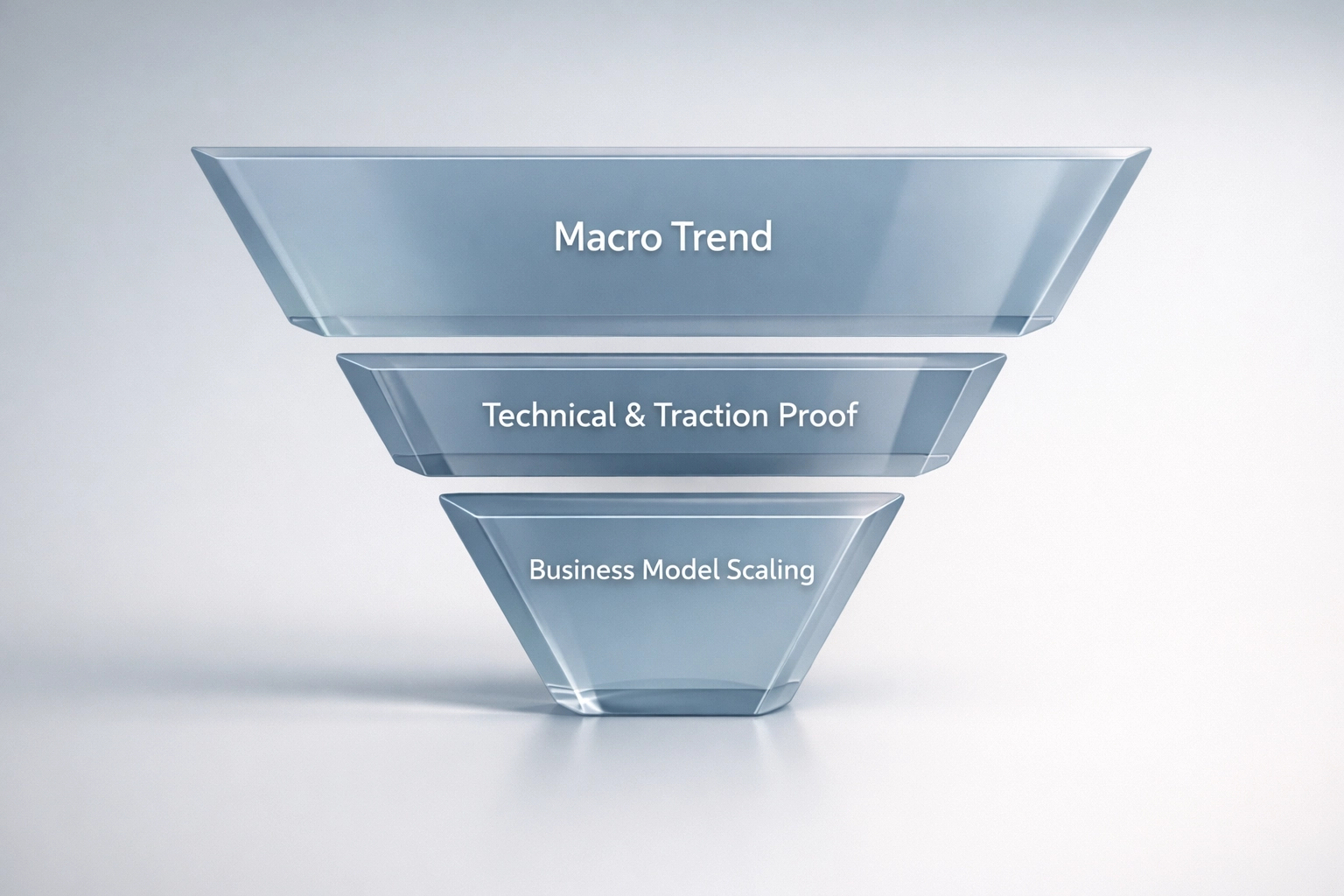
Visual: A minimalist 3D diagram of a V-shaped funnel. The top layers are labeled "Macro Trend," the narrow center is "Technical & Traction Proof," and the bottom layers are "Business Model Scaling."
This structure forces you to spend the most time on the things that actually matter: the data. It moves the conversation from abstract "what-ifs" to concrete "how-tos."
Common Pitfalls: Where Founders Lose the Room
Even with good data, we see founders trip over the same three hurdles:
The "AI-Washing" Trap: Claiming you are an "AI company" when you are really just using a wrapper. In 2026, investors see right through this. If you aren't an AI company, don't pretend to be. Instead, defend your valuation based on your actual competitive advantage.
Skewed Benchmarks: Comparing your startup to skewed AI-inflated multiples. If your comps are unrealistic, your valuation will be too. We’ve written about how to defend your valuation when benchmarks are skewed here.
The Missing Financial Logic: Many founders have a great deck but a weak financial model. If an investor asks a deep-dive question about your COGS and you have to "get back to them," the momentum is dead.
Practical Tip: The "AI-Review" Test
Before you send your deck out, do a self-audit. Use an AI tool to summarize your own deck. If the summary comes back with "The company aims to revolutionize..." instead of "The company has achieved $500k ARR with a 4x LTV/CAC ratio," you have a fluff problem.
You need to make the financial logic of your business impossible to misunderstand. This requires a level of rigor that most founders shy away from. But that rigor is exactly what builds the currency of trust with seasoned investors.
Moving Forward: From Storyteller to Operator
Is vision dead? No. But vision without proof is just a hallucination.
In 2026, the best pitch decks aren't the ones with the flashiest animations or the most evocative storytelling. They are the ones that survive the most intense scrutiny. They are the ones that present a "Massive Proof-Check" on every slide.
At CapMaven Advisors, we specialize in helping founders bridge this gap. We help you move beyond the vision and build the investor-grade financial models and data-driven narratives that VCs actually want to see.
Don't let your next pitch end in the "Delete" folder. Start treating your deck like the technical document it is.
Ready to proof-check your pitch? If you want to ensure your financial model and deck are diligence-ready for the 2026 market, let's talk. You can book an online meeting or a consultation with our team to dive into the math behind your vision.

Summary Checklist for a 2026 Pitch Deck:
The 3-Slide Hook: Do your first three slides contain hard data or just vision?
Unit Economics: Is your path to profitability explicitly clear?
Technical Proof: Have you included benchmarks, architecture, or traction data?
Financial Alignment: Does your deck perfectly match your financial model?
AI-Ready: Is the text clear enough for an automated screening tool to extract your key metrics?
Comments