Does Operational Trust Really Matter in 2026? How Compliance Boosts Your Startup Valuation
- CapMaven Advisors
- Mar 25
- 5 min read
Let’s be honest: in the "good old days" (which, in tech time, was about three years ago), compliance was the thing you did right before an IPO or when a grumpy auditor finally caught up to you. It was a chore. It was expensive. It was, frankly, a buzzkill for the "move fast and break things" crowd.
Fast forward to 2026, and the landscape has shifted beneath our feet. Moving fast is still the goal, but "breaking things" now comes with a price tag that can effectively tank your startup valuation. In an era where AI agents handle half your operations and data privacy is a non-negotiable human right, operational trust isn't just a "nice to have." It’s the difference between a 10x multiple and a "thanks, but no thanks" from the VC committee.
At CapMaven Advisors, we’ve sat across the table from enough investors to tell you the cold, hard truth: the "Risk Discount" is real, and it’s getting steeper. If you can’t prove you’re a grown-up business with the governance to match, you’re leaving millions on the table.
The "Trust Stack": Why 2026 is Different
We’ve officially exited the era of visionary promises and entered the era of radical proof. Investors are no longer just looking at your hockey-stick growth; they’re looking at the structural integrity of the stick.
When we talk about operational trust, we’re looking at three pillars:
Technical Compliance: SOC2 Type II, ISO 27001, and the ever-evolving AI governance frameworks.
Data Sovereignty: Not just "we have a privacy policy," but "we can track every byte of data across its lifecycle."
Governance & Oversight: Having a board and management structure that doesn't look like a group chat among college friends.

A 3D visualization showing the interconnected nodes of a modern "Trust Stack," where data privacy, security protocols, and operational governance form a secure foundation for a scaling startup.
In 2026, 94% of B2B buyers rank trust as the primary driver of their purchasing decisions. If your customers don't trust you, your revenue isn't sustainable. If your revenue isn't sustainable, your startup valuation is a work of fiction.
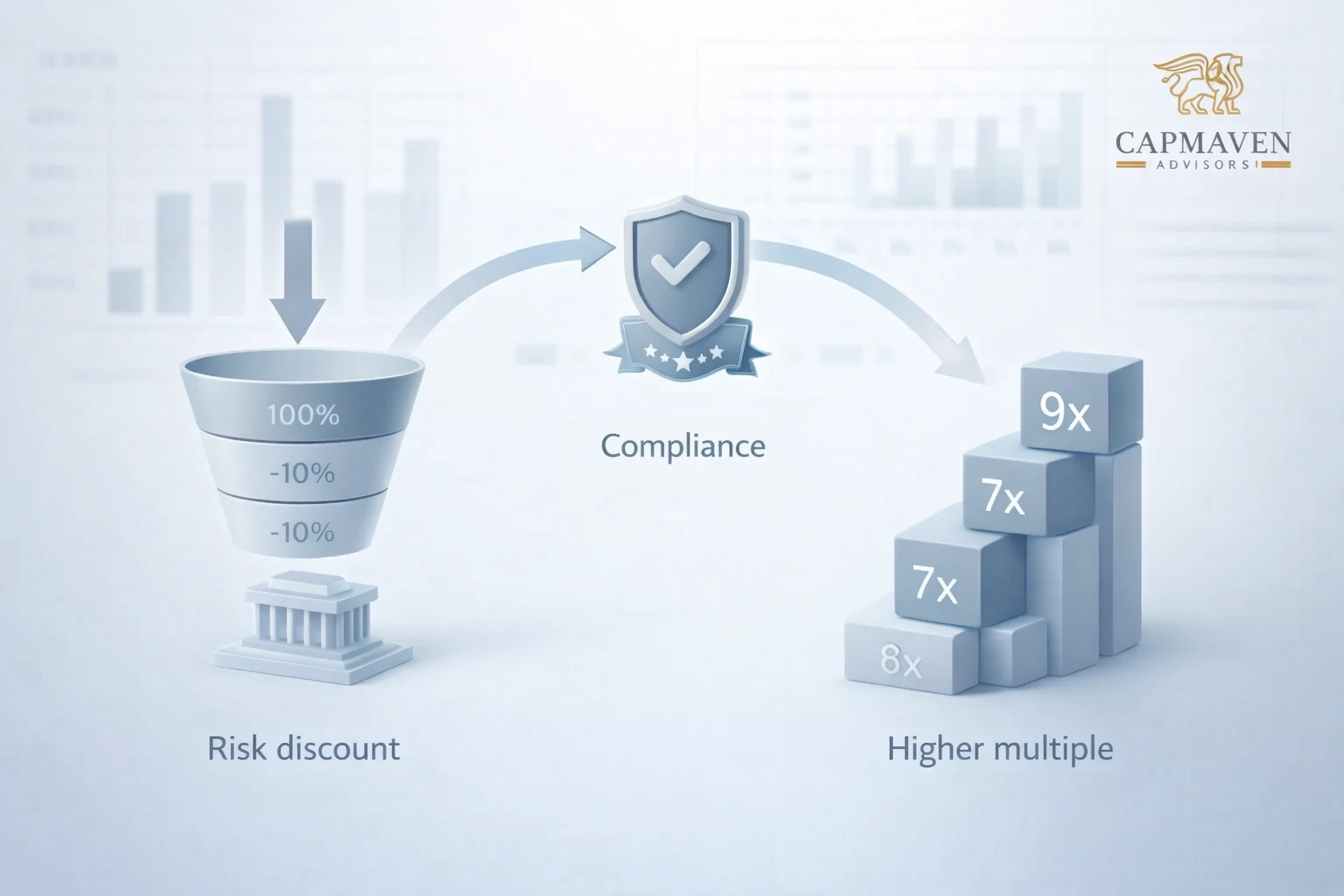
How Compliance Moves the Needle on Your Valuation
You might be thinking, "Penny, how does a SOC2 report actually add dollars to my valuation?"
It’s about the Cost of Capital and Risk Mitigation. When an investor looks at your investor grade financial model, they aren't just looking at the 'Profit' line. They are looking at the probability of that profit disappearing overnight.
1. Eliminating the "Diligence Drag"
We’ve seen deals die in the eleventh hour because the lead investor’s tech-diligence team found a mess of unpatched vulnerabilities and zero data-access logs. When you have your operational trust in order, you breeze through diligence. Speed to close is a massive advantage. A deal that closes in 30 days usually gets a better price than one that drags on for 90 days and gets picked apart.
2. Opening the Enterprise Vault
In 2026, you aren't selling to "startups" anymore: you’re selling to legacy giants who have finally embraced the cloud. These companies won't even look at your pitch deck if you don't have the right security badges on your footer. By investing in compliance early, you unlock a Total Addressable Market (TAM) that is 10x larger and 100x more stable.
3. Improving the Terminal Multiple
Venture capitalists exit through M&A or IPO. If you are being acquired by a public company, they have to absorb your risk. If you are already compliant, you are "plug-and-play." Acquirers will pay a premium for a company that doesn't require a two-year cleanup project post-acquisition.
The Financial Model Connection: It’s Not Just About Revenue
One of the biggest mistakes founders make is keeping their compliance efforts in a silo, separate from their financial strategy. At CapMaven Advisors, we preach that your compliance roadmap belongs in your financial model.
Why? Because compliance has a cost (auditors, tools, security hires), but it also has a massive ROI in terms of churn reduction and increased deal size. If your financial model survives VC diligence, it’s because it accounts for these operational realities.
Practical Tactic: Create a "Trust ROI" line in your internal reporting. Track how many enterprise deals you won specifically because you passed their security audit. Use that data to justify the spend on your next SOC2 renewal.
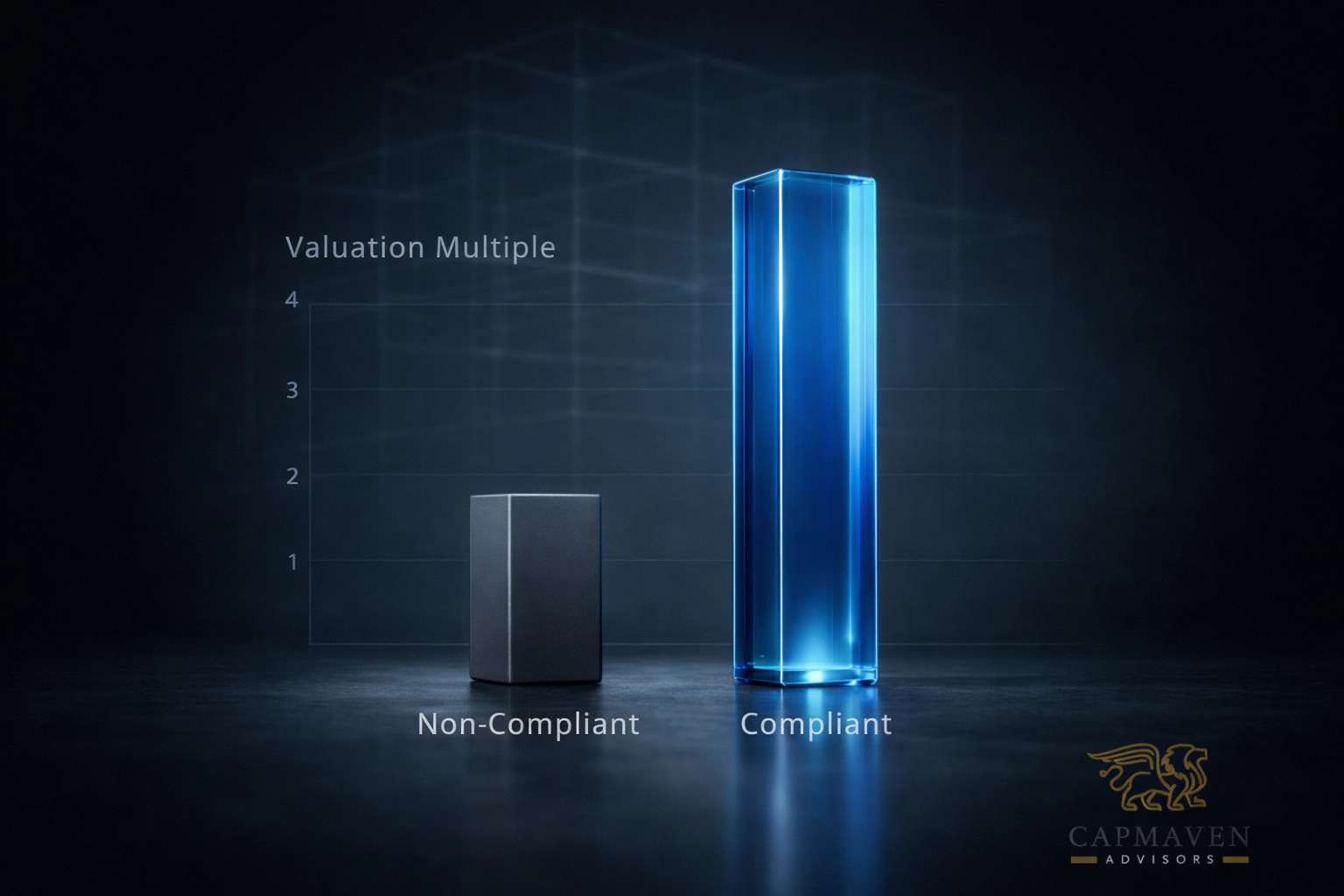
A 3D bar chart comparing the valuation multiples of "Compliant vs. Non-Compliant" startups in the 2026 SaaS market, showing a clear 25-40% premium for companies with established operational trust.
Lessons Extracted: The "Messy Middle" Disaster
Let’s talk about a real-world scenario (names changed to protect the guilty). We worked with a fintech startup: let’s call them PaySwift. They had incredible growth, a viral product, and a team of geniuses. They went out to raise a Series B at a $200M valuation.
During diligence, the lead investor found that PaySwift was using a third-party AI tool to process customer data without a proper Data Processing Agreement (DPA). Worse, their governance was non-existent; the CEO had "God Mode" access to all customer databases.
The investor didn't just walk away; they told their entire network. The "word on the street" was that PaySwift was a liability. Six months later, they raised at a "down round" valuation of $80M. That lack of operational trust cost the founders $120M in paper wealth and massive dilution.
The Lesson: You can’t "fix it later." In 2026, the market is too efficient and too transparent.
Building Your Trust Roadmap (The "Non-Boring" Way)
We get it. You didn't start a company to fill out spreadsheets for auditors. But you did start a company to build a legacy. Here is how we recommend you handle the "Trust Stack" without losing your soul:
Automate the Boring Stuff: It’s 2026. If you’re manually checking permissions, you’re doing it wrong. Use automated compliance platforms that integrate with your stack.
Make it a Culture, Not a Checklist: When you hire your first 10 employees, tell them: "We don't just ship code; we ship trust."
Hire a Fractional Expert: You don't need a full-time CISO at the Seed stage, but you do need an advisor who has "been in the trenches." (Hint: We can help with that).

The 2026 AI Curveball
We can’t talk about 2026 without mentioning AI governance. If your startup uses LLMs to handle proprietary data, investors are going to grill you on "hallucination insurance" and data leakage.
Operational trust now includes Model Transparency. Can you explain why your AI made a specific decision? If your startup is in a regulated space like healthcare or finance, "the black box" is a valuation killer. Proving that you have a "Human-in-the-Loop" for high-stakes decisions is the new gold standard for governance.
Radical Honesty: Is it Worth the Investment?
Look, compliance is a tax. It’s a tax on the disorganized and the reckless. But for the strategic founder, it’s an investment.
We’ve seen the "Barbell Market" play out in real-time. On one side, you have the "toy" startups: fast, flashy, but structurally unsound. On the other, you have the "institutional" startups: built for scale, secure, and radically transparent. Guess which side the smart money is flowing toward in 2026?
If you’re still relying on a "story-driven" deck without the math and the operational proof to back it up, you’re playing a dangerous game. Story-driven decks aren't dead, but they require a foundation of facts to stand on.
Final Thought: Start Today
Operational trust isn't a destination; it’s a muscle. The earlier you start training it, the stronger your company will be when it comes time to hit the market for your next round.
Don't wait for a term sheet to realize your data room is a mess. Be proactive. Build a business that investors "drool over" not just because of your vision, but because of your execution.
Does your current financial model reflect the true value of your operational trust? At CapMaven Advisors, we help founders bridge the gap between "good ideas" and "investor-grade assets."
If you’re ready to stop guessing and start scaling with confidence, let’s chat. We’ll help you build a strategy that doesn't just pass the audit( it wins the round.)
Comments